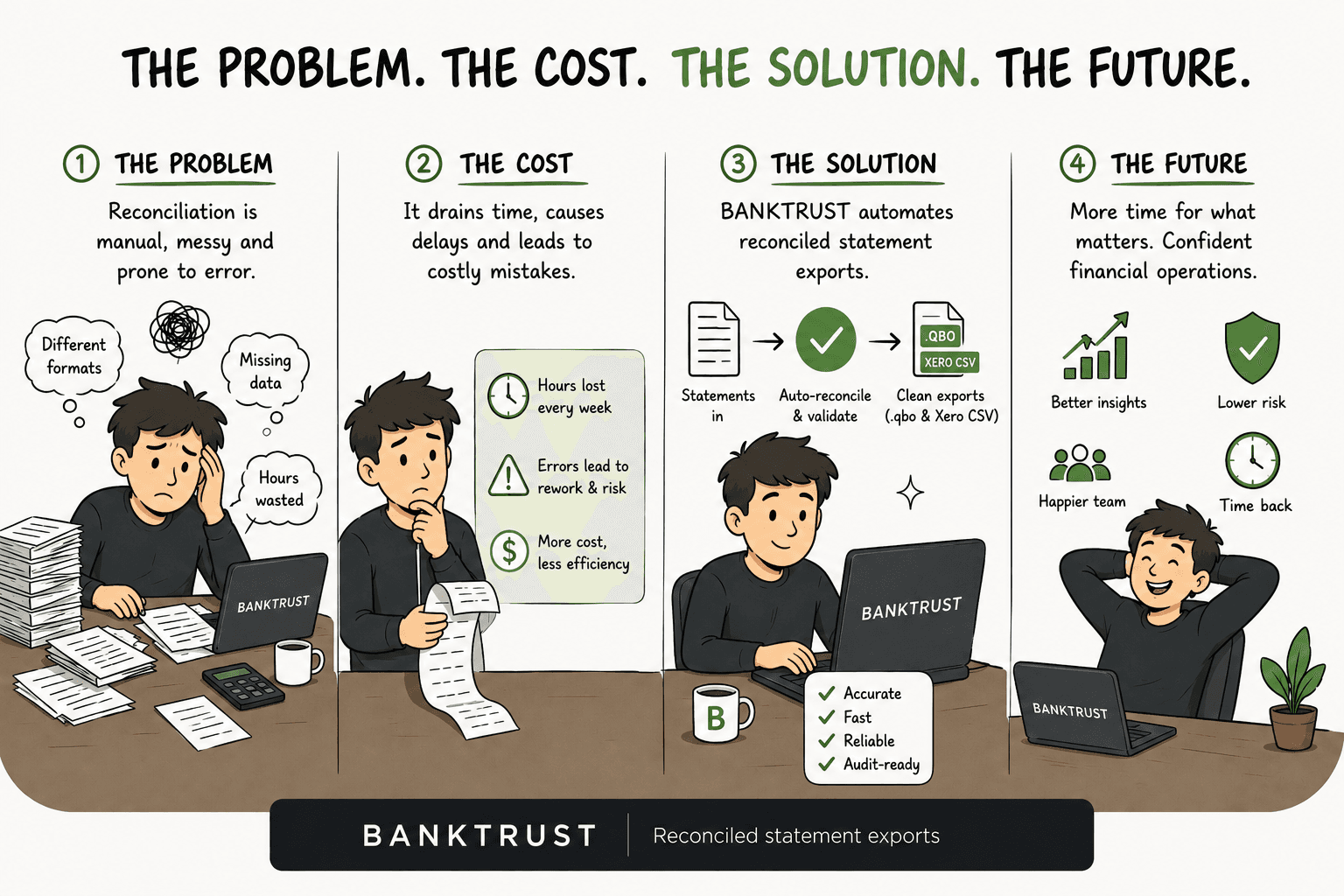
Most bookkeeping problems do not begin with catastrophic failures.
Usually, nothing looks obviously wrong.
The transactions imported.
The balances look reasonable.
The CSV exported successfully.
The workflow technically “worked.”
And yet someone still sits there manually checking everything afterward.
That part is interesting.
Because if modern accounting workflows are supposedly automated now, why does so much time still disappear into verification?
The Real Cost Is Hidden Uncertainty
The more I looked into bookkeeping operations, the more I noticed the same pattern repeating:
The real problem is rarely getting data into the system anymore.
It is trusting the data once it gets there.
A bank statement import can look perfectly clean on the surface and still create reconciliation issues later.
Maybe a few rows duplicated quietly.
Maybe a balance drifted slightly.
Maybe a continuation line broke somewhere inside the parser.
Maybe everything looks fine until month-end reconciliation suddenly does not match.
Those are the kinds of problems that drain time.
Not dramatic failures.
Low-level uncertainty.
The kind that forces accountants and bookkeepers into constant manual review because nobody wants to blindly trust financial data that feels “mostly right.”
<div class="evidence evidence--review"> <strong>Operational reality:</strong><br /> Most reconciliation fatigue comes from uncertainty, not catastrophic software failure. </div>And honestly, that makes sense.
In accounting, “almost correct” is still operational risk.
Why Verification Fatigue Persists
A small variance can trigger hours of investigation.
One malformed import can create downstream cleanup work later.
Even when software works most of the time, people still carry the mental overhead of checking whether this time is different.
That hidden verification work becomes part of the workflow itself.
I do not think most accounting software companies talk enough about that reality.
A lot of tools optimize for:
- faster imports,
- more integrations,
- cleaner dashboards,
- automation optics.
But accounting workflows are not really built around appearances.
They are built around trust.
<div class="evidence evidence--trusted"> <strong>Key distinction:</strong><br /> Extraction success is not the same thing as reconciliation confidence. </div>The Difference Between Extraction and Trust
That distinction became a major part of how we think about BANKTRUST.
We became less interested in:
“Did the statement import successfully?”
and more interested in:
“Can someone actually rely on the output without worrying about hidden inconsistencies?”
Those are very different standards.
Reliable parsing is not just extraction.
Reliable parsing is verified reconciliation.
That means:
- balances align,
- totals agree,
- contradictions surface clearly,
- uncertainty is visible instead of hidden.
Because in real financial workflows, false confidence is often more dangerous than obvious failure.
What Accounting Teams Actually Want
The goal is not just automation.
The goal is reducing the amount of doubt people carry through the workflow afterward.
And honestly, I think that is the part many accounting teams are still searching for.