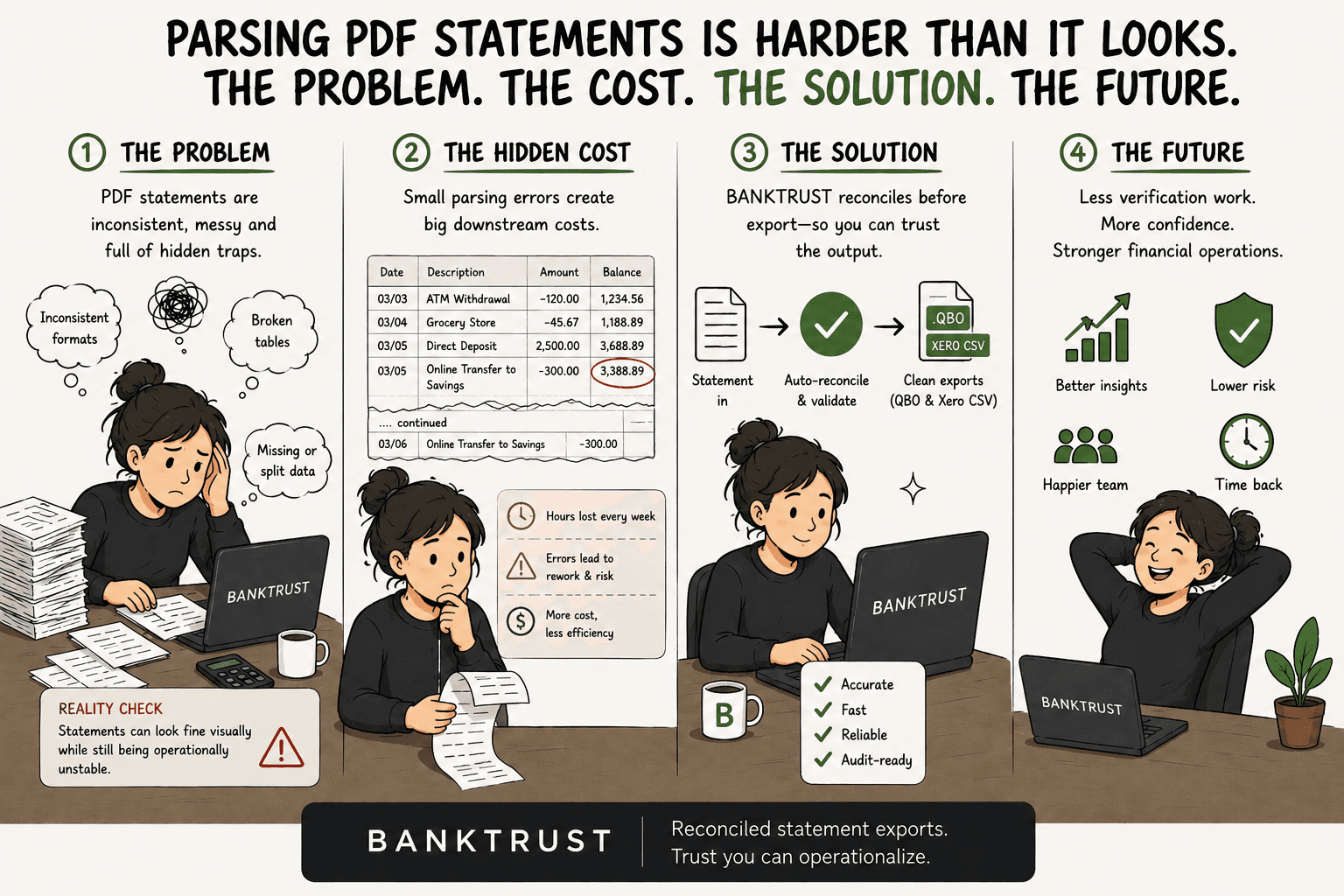
A lot of people assume PDF bank statement parsing is mostly a formatting problem.
The rows need to be extracted.
The columns need to line up.
The amounts need to parse correctly.
The export needs to load into accounting software.
On the surface, that sounds manageable.
And honestly, sometimes it is.
But the more time I spend around real bookkeeping workflows, the more I think people underestimate how much hidden operational trust infrastructure sits underneath seemingly “simple” statement imports.
Because in practice, parsing is not just about reading text correctly.
It is about creating outputs people can stop worrying about.
That is a much harder problem.
The Difficulty Is Not Where Most People Think
A PDF statement can look visually consistent while still being operationally unstable underneath.
A row wraps unexpectedly.
A running balance shifts slightly.
A continuation line detaches from the wrong transaction.
A negative amount parses incorrectly.
A duplicated entry quietly survives into export.
None of those issues necessarily break the import itself.
That is part of the problem.
The workflow still appears successful.
The CSV exports.
The transactions load.
The accounting system accepts the file.
And then the real work begins afterward.
Someone compares balances manually.
Someone traces transactions line by line.
Someone spends thirty minutes trying to understand why something “feels off.”
That pattern shows up constantly in financial workflows.
Not because accountants dislike automation.
Because uncertainty changes human behavior very quickly once money is involved.
<div class="evidence evidence--review"> <strong>Operational reality:</strong><br /> A workflow can appear technically successful while still creating downstream verification work. </div>Why Financial Workflows Behave Differently
I think this is where a lot of software discussions become slightly disconnected from operational reality.
Many systems evaluate parsing quality through metrics like:
- extraction coverage,
- transaction counts,
- successful imports,
- processing speed,
- automation rates.
Those metrics matter.
But accounting workflows do not really optimize around appearances.
They optimize around confidence.
A parser can technically extract 99% of the statement correctly and still create disproportionate operational friction if nobody fully trusts the remaining 1%.
That remaining uncertainty spreads.
People start double-checking totals.
They verify balances manually.
They compare exports against the original PDF.
They carry low-level hesitation into the rest of the workflow.
The verification work expands naturally around the uncertainty.
That dynamic matters more than most systems acknowledge.
The Difference Between Extraction and Reconciliation
This is probably the most important distinction.
Extraction answers:
“Did the system pull the data?”
Reconciliation answers:
“Can the output actually be trusted operationally?”
Those are very different questions.
And in financial workflows, the second question usually matters more.
A clean-looking export is not automatically a reliable export.
A successful import is not automatically a trustworthy workflow.
That is part of why reconciliation matters so much operationally.
Reconciliation acts like a constraint against hidden ambiguity.
It forces the workflow to prove consistency instead of merely producing output.
<div class="evidence evidence--trusted"> <strong>Key distinction:</strong><br /> Extraction success is not the same thing as reconciliation confidence. </div>Why “Mostly Correct” Creates So Much Friction
One thing I did not fully appreciate early on was how expensive partial trust becomes inside recurring workflows.
People can tolerate slow systems surprisingly well.
What they struggle to tolerate is uncertainty they cannot localize.
Especially repeated uncertainty.
A workflow that produces occasional unexplained variances slowly trains people to distrust the workflow itself.
And once that happens, manual verification becomes permanent behavior.
Not because the software completely failed.
Because people stop feeling safe delegating trust to it.
I think that is part of why financial software often creates invisible operational fatigue even when the surface-level automation metrics look impressive.
The workflow technically improved.
But the cognitive load remained.
Sometimes it even increased.
Why Observable Systems Matter
The more I think about statement parsing, the less I think financial systems should behave like black boxes.
Especially in accounting.
People need ways to:
- verify outputs,
- understand mismatches,
- trace reconciliation logic,
- inspect uncertainty,
- review anomalies before export.
Not because operators are resistant to automation.
Because trust requires observability.
And financial workflows become surprisingly fragile when uncertainty is hidden instead of surfaced clearly.
That realization has shaped a lot of how we think about BANKTRUST.
Not as a system optimized purely for extraction speed.
But as a reconciliation-first workflow where trust, verification, and visible proof are treated as part of the infrastructure itself.
Because ultimately, the hardest part of statement parsing is not reading the PDF.
It is producing outputs people can confidently stop rechecking afterward.